

The WSCCE Spotlight Interview: Amber Glennon, NW LECET
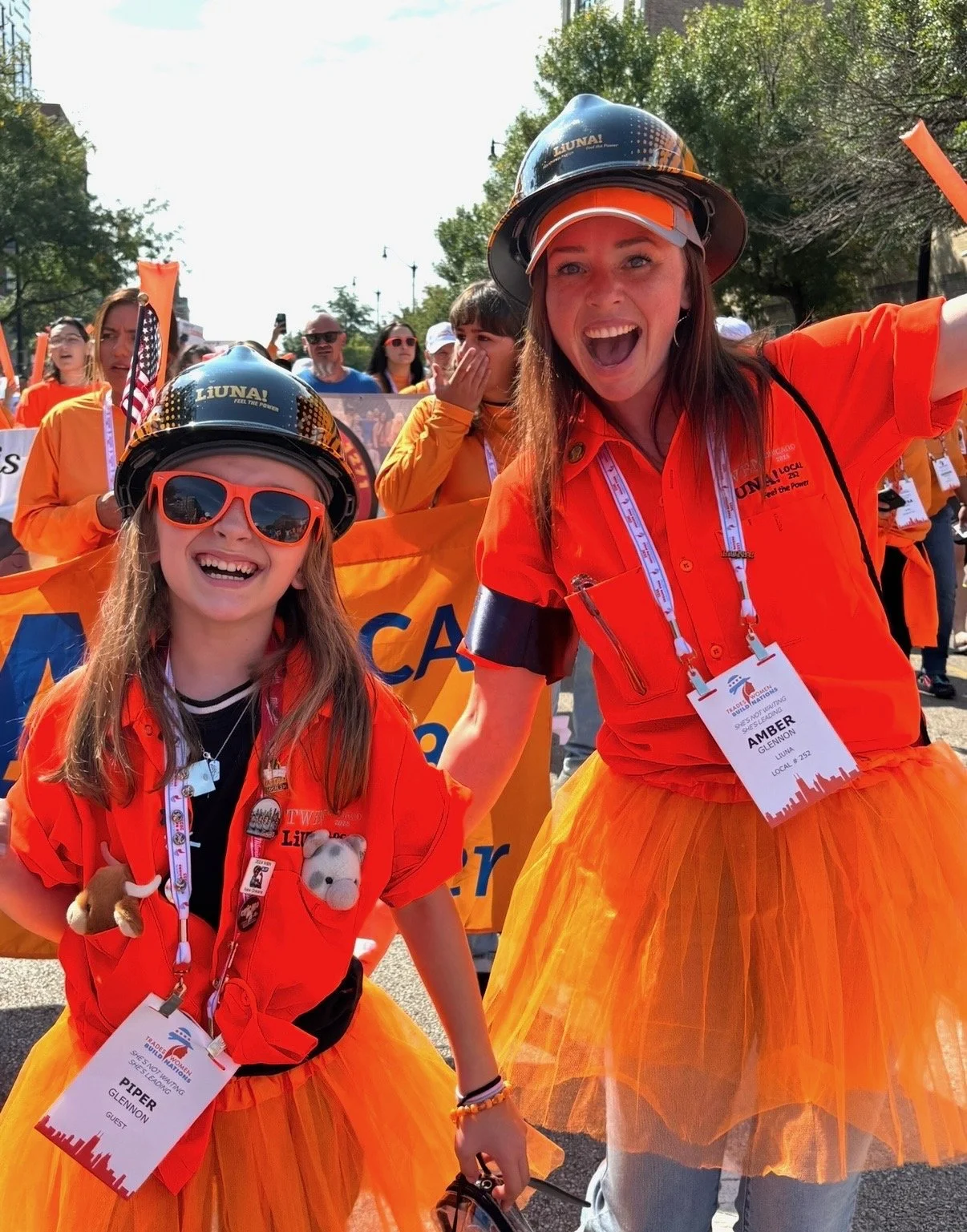
Amber and her daughter representing LIUNA Local 252 at Trades Women Build Nations.
From her history as a second-generation Laborer to inspiring her daughter, NW LECET Marketing Rep Amber Glennon shares her story, along with more on women in construction, the role Unions like LIUNA play, and the idea that everyone deserves a second chance.
Washington State Construction Center of Excellence (WSCCE): As a marketing representative for the Laborers’-Employers Cooperation and Education Team Northwest (NW LECET), what does a typical day look like? And what does an unusually busy or a unique day look like?
Amber Glennon: On a daily basis, we work with our team to assist our Affiliates, which are our Locals and District Councils and also our Union signatory Contractors, along with our Members to increase market share and create more job opportunities. That could look like doing research, social media, design and storytelling, recruitment efforts, energy and policy involvement, or building and maintaining partnerships with our Contractors.
Honestly, I've been really busy since I've started and every day is different, but it's very much a team effort. We're a great team that works together.
WSCCE: How did your time as an apprentice and years as a journey worker prepare you for the career and the work you do now?
Amber Glennon: I'm still a laborer, I will forever be a laborer. But starting out in the field as an apprentice, it teaches you how to be a Union Member, a LIUNA Member, going to classes and getting involved with the Union, I think that really helped me see the bigger picture of what a Union is there for, and what it does for you. That really sat well with me and my values.
I went from working out in the field as an apprentice doing demolition and abatement work, flagging, environmental work, to journeying out and to working in the office of a Contractor doing change management . I have worked for a stationary unit, Kitsap County roads department, and then I got to work as an organizer for our district council. Now I am a construction marketing representative for our NWLECET team. You learn different things as you go through each chapter in your life. The hard work and dedication of showing up, being on time, staying focused and most importantly having passion for what you do are things you take with you to each chapter.
WSCCE: What first drew you to construction? Was there a specific moment or experience from early in your life that sparked your interest in the field?
Amber Glennon: I grew up in a blue-collar household. My dad went through LIUNA’s apprenticeship program, so I am a second-generation laborer. I worked at the shop where my dad worked, it was a demolition company located in Tacoma. I ran errands, communicated with vendors, helped load up machines on lowboy trailers, kept the shop tidy and helped get materials together for various jobs. After I had my daughter I decided to take some time off of work to raise her, and what was supposed to be just a couple months turned into about 2 years.
When my daughter was about 2 years old, her dad and I decided to end our relationship. I knew I was going to need a job and one that provided benefits and good pay. So I called a friend of mine who worked at the company that I worked for previously. I told him that I needed a job with good benefits and pay, and did he think I could make it in the Union? He said, absolutely. I started out working on a crew of about 30 guys and I was only female for a while.
Essentially it was my dad and mom that really inspired me to join and get in, but knowing I needed the benefits and the money and just knowing that I could do it.
WSCCE: What are the most effective ways are to promote trades to young women? What have you seen that’s succeeded, or failed, in outreach to young women?
Amber Glennon: LIUNA is a great organization to work for if you are a woman. Construction has historically excluded women.
I think it starts with at home and younger girls. Instead of saying, “you throw like a girl,” say, “you throw like an athlete.”
It also starts with kids at a younger age, and I can say that speaking from experience with my daughter, she can do anything. She said to me, “mom, do you think one day I could play in the NFL? And go to the Super Bowl with the guys? Do you think I could do that?” Mind you, she's a tiny little girl. I said, “Yes, you can, you just have to put your mind to it.” I think that's where it starts for all of us as parents and as caregivers, to really be cognizant about what we say around children.
Also promoting the trades and Union Apprenticeship going into the elementary schools and going into the middle schools and really educating not just the children, but the teachers, the instructors, and the people in the community that make a difference that these kids see every day, that this is an option. You don't need to go to college to make good money and have a happy life.
WSCCE: You started a Women in the Trades group in Pierce County. What led you to start it? What gaps were you trying to fill? And what kinds of topics or issues does the group take on today?
Amber Glennon: Just to be clear, I did not start this group on my own. I kind of took charge of it, but I would be so wrong if I took the credit for it. We had probably 6 of us that got together, and we were going to Tradeswomen Build Nations conference put on by NABTU (North America’s Building Trades Unions).
We're getting ready to leave for that, and we started this group message. We're going to this conference together in a different state, so we really needed to stick with each other, you know? We came back from this conference with a fire lit under all of us, it's so empowering, all these women's conferences, so powerful, and you feel like superwoman when you get home.
We didn't want that momentum to stop. We had the support from our Business Manager and our Assistant Business Manager, and so we started meeting monthly. I didn't even know what we were doing when we were doing it. We didn't intentionally build the women's committee, but that's what it turned into. Eventually, it got to a point where we're like, okay, we need to start keeping notes, we need to start keeping track of what we're talking about. Our first record of keeping notes was November of 2023.
We all come from different places, all of the women in this group. We all love each other, and we make sure that we know we're there for the same reason.
I lead the women's committee for about 2.5 years, and now I am no longer the chair. There's two co-chairs on that women's committee now, and that opens up avenues for leadership, for these women to take on that role of a chair and really know and understand what it's like to be a leader. You have to do it to learn how to do it.
WSCCE: What encouragement and knowledge do you want to pass forward to the next generation regarding the construction industry? What is something you wish would have been shared with you when you first started in the industry?
Amber Glennon: You really have to learn how to humble yourself. It's not just me doing something, it's a collective thing, and I think that that's really important for people to understand. To have the mentality that its WE and not just ME. That is what a Union is about.
If I were talking to a group of girls right now, I would say, “you can do anything you put your mind to, and don't let anybody ever tell you differently.” And find a mentor! We have many mentors in our careers and I am thankful for each and every one of my mentors I have had, and the ones I am yet to have.
With the women's group, I would be up at 1 in the morning, not able to sleep, and I would Google, how do you run a women's committee? How do you start? What's an opening theme for a women's committee? That's when we started doing icebreakers, to kind of loosen things up, and having guests. Like, what do we do with having guests? So, I would research it.
I'm so passionate about this, because of my daughter, I think of what I say to her all the time, “you are beautiful, you are strong, you are smart, and you can do anything.” I am her biggest fan, she is my hero. I love her so much. She's the reason why I've pushed so hard to get where I am, and I will continue to push to show her we can do this.
WSCCE: Thinking back to the steps in your career, what was it like to be an apprentice, and what was the role that mentorship played in the process?
Amber Glennon: I believe mentorship is super important in any industry. I have had many mentors. when I was an apprentice, my first foreman. Before that, my parents were my first mentors, and that's something to drive home to people: you are your children's first mentors. They are sponges, and they're going to do everything you do.
My parents, they are such great people, and I still look up to them today.
When I first started in the apprenticeship, I didn't have much of a backbone, so my first foreman was my mentor. He also showed me how to do all of his paperwork, which served him, but I turned it into a silver lining, getting to learn all of this stuff. As a brand new apprentice, that is amazing.
Chuck and John, the business manager and assistant business manager, they both really pushed me. But also let me make mistakes, and then would tell me, “I knew you were gonna do that.” They also helped me get back up and on track. I had that autonomy, and was able to keep my own voice, which I think is especially important as a woman in construction.
In my new role I have a mentor who is a woman. I've never had a woman mentor. I've never had a woman boss, even. In the construction industry, in a leadership role, having a woman mentor and boss is different, but it's relieving at the same time. Like, she understands periods and momming and hormones and all these things that women deal with that. So it's different to have somebody really understand that.
WSCCE: How can we improve physical safety and psychological safety on the job?
Amber Glennon: On the mental health side of things: understand and be there for each other a little bit more. Understand that construction industry is predominantly male, and our male counterparts have a lot of weight on their shoulders. You have a lot of men who have a family to feed, and you can get laid off, and then it's scary.
With mental health, we just really need to open that door for everyone to really understand that you're not alone. We're all in this together. Don't let politics or what you believe in make you think that you're better or less than somebody.
On physical safety, I think the same thing. The industry is always changing, so doing more Toolbox Talks is really important, and including leadership on that, including marketing reps, and the folks in the office that have never been on a job to understand this is what happens and this is what can happen.
The mental health part of it is always talking about it, being okay with saying, “Are you okay? Do you think you're going to hurt yourself?” Being okay with having that conversation with somebody, especially in the construction industry.
We have a great program with our health and safety people, on mental health. We put together suicide awareness packets.
WSCCE: Is there anything else you'd like to share about the industry, your role, or the future of construction?
Amber Glennon: Construction's always changing. It’s not just the little girls, it's anyone, that you can do anything you put your mind to. I started off as an apprentice knowing nothing. It’s about believing in yourself.
The Union stands for equal rights on the job, equal pay, equal training, equal opportunity for advancement, and I think that stands true for myself in the apprenticeship program. Statistically, I should be working somewhere that does not have this good of pay and benefits. I think it's really important that people understand, no matter what you've been through in your life, there's always a second chance.
When I first started, I always heard that the construction industry was a man’s world, and I have come to find out that is not the case anymore. Find your tribe and build on that. Women are powerful and just as, if not more, capable than any man. You just need to work smarter, not harder!
I recently helped a guy who just got out of prison. I went up as an organizer into the prison up in Forks. And I just told them my story, what I've been through.
This gentleman got out of prison and he called me. I gave him my business card, he called me, and he's now in our apprenticeship program and he is thriving. And that, to me, is such an amazing testimony to what we do as an organization, and what they train us to do, and also as human beings, right?
Helping people and paying it forward makes me feel so good. He's now in an apprenticeship class. It’s pretty cool to hear, “I'm in this class, this is my instructor, and I'm doing so good.” I'm like yes, man, that is great.