

From Blueprint to Balance: Building an Industry that Works for Women Experiencing Menopause
WSCCE guest columnist Mathilde Roux is a policy analyst with experience advancing economic, gender, and racial equity through policy analysis, research, and federal program implementation. Her expertise includes menstruation and menopause in the workplace, paid leave, childcare, workforce equity, and social safety net policy. Mathilde spent five years with the US Department of Labor’s Women’s Bureau where she spearheaded the creation of a brand new portfolio of work on menstrual equity, menstruation, and menopause at work. Mathilde holds a Master of Public Policy and a Bachelor’s degree in Planning and Public Policy, both from Rutgers University. In her spare time you can find her reading every book she can get her hands on, crocheting gifts for friends and family, and advocating for women and people in her community.
For more information regarding menopause equity in Washington state, we are proud to recommend the Washington State Women’s Commission website: https://wswc.wa.gov/health/menopause-equity/
What is Menopause?
Menopause affects anyone with ovaries, but experiences vary dramatically. While some sail through with minimal symptoms, others face serious disruptions that can make work difficult or unsafe. When employers fail to understand or accommodate menopause, they risk losing experienced workers or creating preventable health and safety hazards. The good news? Creating a menopause-responsive workplace is straightforward and low-cost.
The menopause transition[1] consists of three phases:
Perimenopause: the transition period occurring between two and eight years before menopause, during which hormone changes may cause a variety of symptoms.
Menopause: the point in time 12 months after the last menstrual period.
Postmenopause: the time period after the official menopause, during which symptoms may ease and new health risks may develop.
Although the average age of menopause is 52 in the United States, perimenopause and its symptoms may begin much earlier. Additionally, some people go through premature (before age 40) or early (between ages 40 and 45) menopause, sometimes due to medical conditions or treatments.[2]
For purposes of this blog, we will use the term menopause to encompass all phases of the transition. It is important to recognize that symptoms and health risks differ across the phases of the menopause transition.
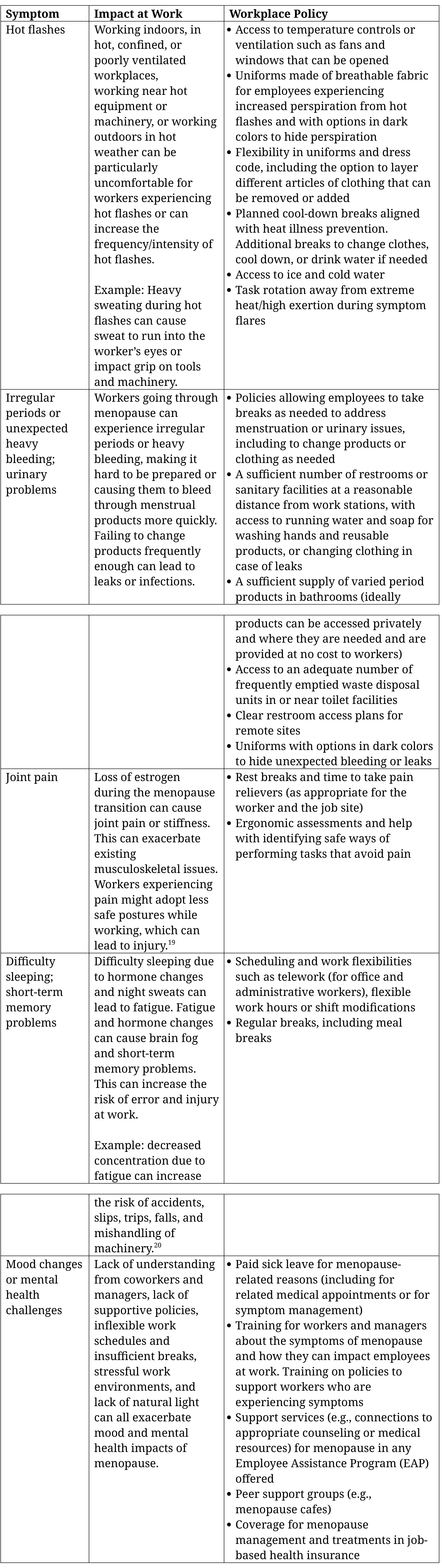
Symptoms during the menopause transition are varied and many of them can affect people at work,[3] such as: Hot flashes, irregular periods or unexpected heavy bleeding, urinary problems, including incontinence, joint pain[4], difficulty sleeping, short-term memory problems, mood changes or mental health challenges (such as anxiety and depression). These symptoms are common and not everyone will experience every symptom. Lifestyle changes or medical treatments can help alleviate symptoms. Risk of certain health conditions increases after menopause, including heart disease, stroke, osteoporosis, and urinary incontinence.[1]
No one is required to disclose private medical information at work. If symptoms are severe or disruptive, a medical provider can help identify strategies and appropriate treatments. A medical provider can also screen for related health conditions and provide guidance for minimizing risks.
The Business Case for Menopause Support
According to the Bureau of Labor Statistics, women make up 11.2% of workers in the construction industry (which includes office and administrative occupations), and 4.3% of workers in construction and extraction occupations.[2] This means that many workers have gone, are going through, or will go through the menopause transition while employed in construction. In addition to managing symptoms, those going through menopause may face stigma and lack of understanding from those around them. This is especially challenging in male-dominated industries where they may have few or no colleagues who understand what they are experiencing. Because the menopause transition is associated with aging, some workers may be hesitant to share their experience for fear of being treated like they can no longer do their job well. In reality, they are still highly skilled and capable but may just need small adjustments to continue to reach their full potential. Some workers have also faced harassment and unwelcome remarks, including jokes, related to their symptoms.
Construction employers should be aware of the symptoms and health risks that accompany this stage of life. Failing to address menopause at work can cause absenteeism and retention issues if workers are unable to manage their symptoms at work. It can also increase workers’ risk of injuries or health issues. We can reduce those risks and support people through practical jobsite controls and accommodations, many of which are low or no cost. You may find that many of the jobsite controls and accommodations suggested in this blog are already implemented in your workplace. And implementing them may also benefit workers who are not going through menopause.
Legal Considerations
Employers may face legal issues under federal or state law for failing to address menopause adequately in the workplace. In July 2025, Washington State began enforcing a state law requiring construction employers to provide time and space for workers who menstruate or express breast milk to attend to those needs.[3] The law requires employers to provide access to restrooms and an adequate and convenient supply of menstrual hygiene products at no cost.[4] Specifically:
Access to restrooms: Minimum size bathroom-equivalent to a standard sized portable chemical toilet; Internal latch (lock) to prevent inadvertent entry; and Adequate time to accommodate for multiple layers of clothing while using the room.
Adequate and convenient supply of menstrual hygiene products at no cost to employees:
Products must be located in all gender-neutral bathrooms and bathrooms designated for workers who menstruate, or
Provided in kits for each worker who needs such product.
Washington State also has state paid family and medical leave[5] and paid sick leave laws.[6]
Failing to accommodate menopause could violate federal laws prohibiting discrimination, including harassment,[7] on the basis of age,[8] sex,[9] disability[10] or a combination of these characteristics. While menopause is not a disability itself, in some instances symptoms may meet the definitions outlined in federal laws such as the Americans with Disabilities Act (ADA).[11] In some cases, individuals experiencing severe symptoms related to the menopause transition may qualify for leave under the Family and Medical Leave Act.[12] Employees may also be covered by sick leave requirements for federal contractors.[13] The sanitation standards adopted pursuant to the Occupational Safety and Health Act require employers to provide sanitation facilities for workers in construction.[14]
How to Address Menopause on the Job Site
To support employees and create a menopause-responsive work environment, employers should establish menopause workplace policies and a process for providing workplace accommodations. Employers can solicit input from employees while designing policies to ensure that they are responsive to the varied needs of workers. Once policies are established, they should be widely disseminated, and supervisors should be trained regularly on their implementation.
Final Thoughts and Call to Action
Menopause isn't a niche issue—it's a workforce reality affecting thousands of construction workers right now. The accommodations outlined in this blog aren't expensive or complicated, but they can mean the difference between retaining a skilled worker and watching them leave the industry. More importantly, they signal that your workplace values all workers' health and dignity. The construction industry has made strides in becoming more inclusive—addressing menopause is the next logical step.
Employers: Establish a clear process and contact person for requesting support or workplace accommodations, and incorporate menopause in risks assessments and safety conversations. Train workers and supervisors/forepersons on menopause and applicable policies and contacts.
Supervisors/forepersons: Learn about menopause and its symptoms, and employer policies for supporting workers going through menopause. Respond openly to requests for support, focusing on job barriers, safety and health, and potential accommodations. Avoid and discourage jokes/comments related to menopause.
Workers: Contact HR, supervisor, union rep, or EAP for support if needed. Be prepared with suggestions for accommodations based on your individual symptoms and job type.
Coworkers: Avoid jokes/comments. Respect privacy of colleagues, but offer judgment-free support and respect accommodations.
Unions: Consider the needs of workers experiencing menopause when negotiating contracts and work with employers to ensure compliance with applicable laws (e.g., accommodation measures, access to restrooms and menstrual products, leave and scheduling policies).
Resources
Information about menopause: The Menopause Society (https://menopause.org/)
List of menopause certified healthcare providers: The Menopause Society (https://portal.menopause.org/NAMS/NAMS/Directory/Menopause-Practitioner.aspx)
Workplace guides: Making Menopause Work by The Menopause Society (https://menopause.org/workplace), Menopause Workplace Resource Guide by the Society for Women’s Health Research (https://swhr.org/resources/menopause-workplace-resource-guide-for-managers/)
Resources on women’s health and safety and opportunities for collective bargaining: USW’s Action Guide for Raising the Bar on Women’s Health and Safety (https://usw.org/get-involved/women-of-steel/usw-action-guide-for-raising-the-bar-on-womens-health-and-safety/)
Legal analysis: Menstruation, Menopause, and the Pregnant Workers Fairness Act by Marcy Karin and Deborah Widiss (https://papers.ssrn.com/sol3/papers.cfm?abstract_id=4991264)
Menopause Equity in the Workplace by the Washington State Women’s Commission (multiple documents available): https://wswc.wa.gov/health/menopause-equity/
Citations
[1]https://womenshealth.gov/menopause/menopause-and-your-health
[2] Bureau of Labor Statistics Current Population Survey, 2024, Tables 11 and 18: https://www.bls.gov/cps/demographics.htm#women
[3] RCW 49.17.530: https://app.leg.wa.gov/RCW/default.aspx?cite=49.17.530
[4]https://www.lni.wa.gov/safety-health/safety-topics/industry-topics/sanitation-in-construction
[5] Title 50A RCW: https://app.leg.wa.gov/rcw/default.aspx?Cite=50A
[6] RCW 49.46.210: https://app.leg.wa.gov/rcw/default.aspx?cite=49.46.210
[7]https://www.eeoc.gov/laws/guidance/enforcement-guidance-harassment-workplace
[8]https://www.eeoc.gov/age-discrimination
[9]https://www.eeoc.gov/sex-based-discrimination
[10]https://www.eeoc.gov/eeoc-disability-related-resources
[11]https://www.eeoc.gov/disability-discrimination-and-employment-decisions; https://askjan.org/publications/consultants-corner/vol09iss01.cfm
[12]https://www.dol.gov/agencies/whd/fact-sheets/28p-taking-leave-when-you-or-family-has-health-condition
[13]https://www.dol.gov/agencies/whd/government-contracts/sick-leave
[14]https://www.ecfr.gov/current/title-29/subtitle-B/chapter-XVII/part-1926/subpart-D/section-1926.51
[15]https://www.constructioncenterofexcellence.com/toolbox-talks/ergonomic-series-sprains-strains
[16]https://www.constructioncenterofexcellence.com/blog/zpcamb7gop35qcehfacrewsm5b3bg7
[1]https://womenshealth.gov/menopause/menopause-basics
[2]https://womenshealth.gov/menopause/early-or-premature-menopause
[3]https://womenshealth.gov/menopause/menopause-symptoms-and-relief
[4]https://mcpress.mayoclinic.org/menopause/could-this-be-menopause-exploring-lesser-known-symptoms-and-what-to-do-about-them/